I live in emigration myself, with a child, and I noticed that my daughter was finding it hard to hold on to her Belarusian identity and make new friends. I thought this might be a struggle not only for children in my immediate circle, but for many others too. That turned out to be true: children came to us (to the camp, ed.) who had gone a long time without being able to make friends with anyone. And it was in the camp, over just one week, that they found their people. They bonded so well they even set up group chats for their session!
The first time, we organised the summer camp using 1.5% tax allocation funds through the SVAE initiative. That was our crash test — and it turned out the idea really resonated. The second time, it was made possible with the support of the Charitable Foundation "A Country to Live in", funded through the International Humanitarian Fund.
.jpg)
These are extraordinary children. Adults make the choice to emigrate and understand all the consequences, but children, of course, are never asked whether they want to leave or not. For them, it is also an enormous source of stress. They tear apart their friendships and family bonds and are left face-to-face with a new life. Finding the right approach, melting those little hearts — that is, of course, a serious challenge.
But I've been lucky with my team — they are very sensitive people who approach the work with great love. We see with our own eyes how prickly little hedgehogs arrive, and kittens with tears in their eyes leave. They beg to stay or come back. We even hear: "Let us help in the kitchen — just let us come to camp one more time!"
.jpg)
I didn't choose the Białowieża Forest by chance. This is a place where the Belarusian national minority lives in Poland. The forest itself is a point of connection between Belarus and Poland — a place where we, finding ourselves at a crossroads, can find our home, drawing on the local community. Where people speak a language very close to Belarusian, even if with their own accent.
One of my most important values is a Belarusian-speaking team and a strong cultural element. In our programme, we explore traditions and culture: the "Kalinowski Rebels" come to visit, put on theatrical shows, we paint bags inspired by traditional woven rugs, and we get acquainted with vitsіnanka (paper-cutting art) and straw weaving.
Another very important element is ecological awareness. It matters a great deal to me to instil in children a careful and caring attitude towards the natural world.
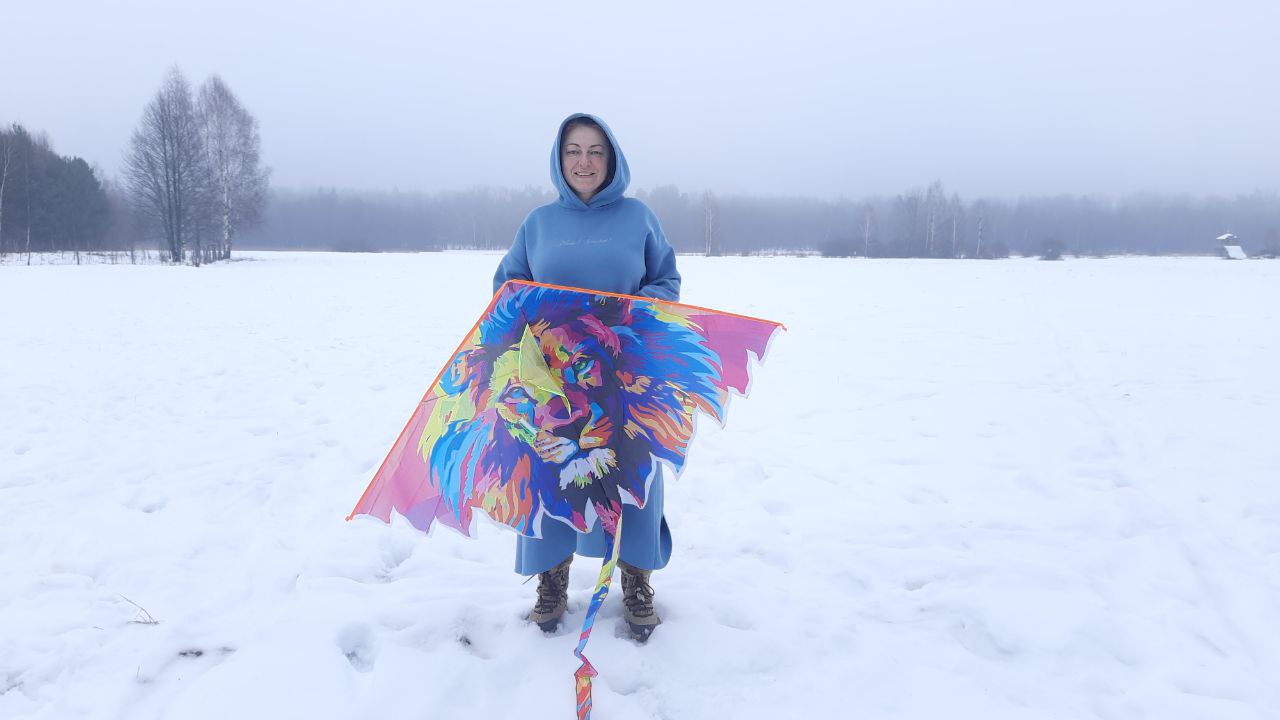
The programme was different, because winter turned out to be genuinely wintry — with hard frosts. So we were limited in how much time we could spend outdoors. Even so, we built an igloo (a traditional Inuit dwelling in the shape of a dome made of snow and ice), made ice cream outside, and had what felt like a very summery activity — flying kites. Our classic hikes through the forest look completely different in winter: first, the winter forest itself is strikingly beautiful, and second, you can spot the tracks of different animals.
.jpg)
For me, the hardest part was navigating Polish legislation and gathering all the necessary certificates and documents, drawing up contracts — that was quite a challenge.
The result. And you see it within just a few days, when the children are already more relaxed, when they start to play and mess around and just be kids. When they live their childhood — even though they've grown up very quickly because of what they've been through.
And when messages start coming into the group chat after the session — that fills our hearts with incredible joy, because we understand that none of it was in vain.
Or take Auntie Volia's kitchen, for example. I think we'll need to add a line to our intake conditions: "Dear parents, please be aware: after your child has spent time at camp, you may find yourself in competition with our cook."
I've come to realise that if I never get to go back home, perhaps I'll stay in the forest. I love organising the camp, being there, introducing children to the forest and the world around them so much that returning to "civilisation" gets harder with every session (smiles).
What moves me personally is when children start to trust us and share their stories — usually the older ones. About house searches, about hiding, about crossing the border on the run, about how frightening it was to walk into a new school without knowing the language, about having no friends in a new country.
The first time this happened to me, I was at a loss — all I could do was listen. Now I know how to support them.
Another very touching moment is at the train station, when I hand the children back to their parents, and they hug me — often in tears.
.jpg)
Honestly, Belarusian identity in emigration is no different from Belarusian identity in a Russified Belarus. The same strategies we used to fight for our identity at home work anywhere in the world.
Children don't always understand why they need to learn the language, why they should care about Belarusian culture. But when you offer them certain patterns, when they see that it's beautiful and interesting, that it's not only about pain, loss and suffering — but also a reason to feel proud — that stays with them.
That's a hard one. Probably: Belarusian identity, ecology, friendship.
When the summer session ended, I said goodbye to my team as if that was it — the magical adventure was over. And when we managed to find funding through the Charitable Foundation "A Country to Live in", it was an incredible gift — for me, for the team, and for the children, of course.
My dream is to never again have to think, after a session ends, that this is it — that it's all over.
Every donation helps support political prisoners and their families, giving them hope and the means to overcome challenges.


